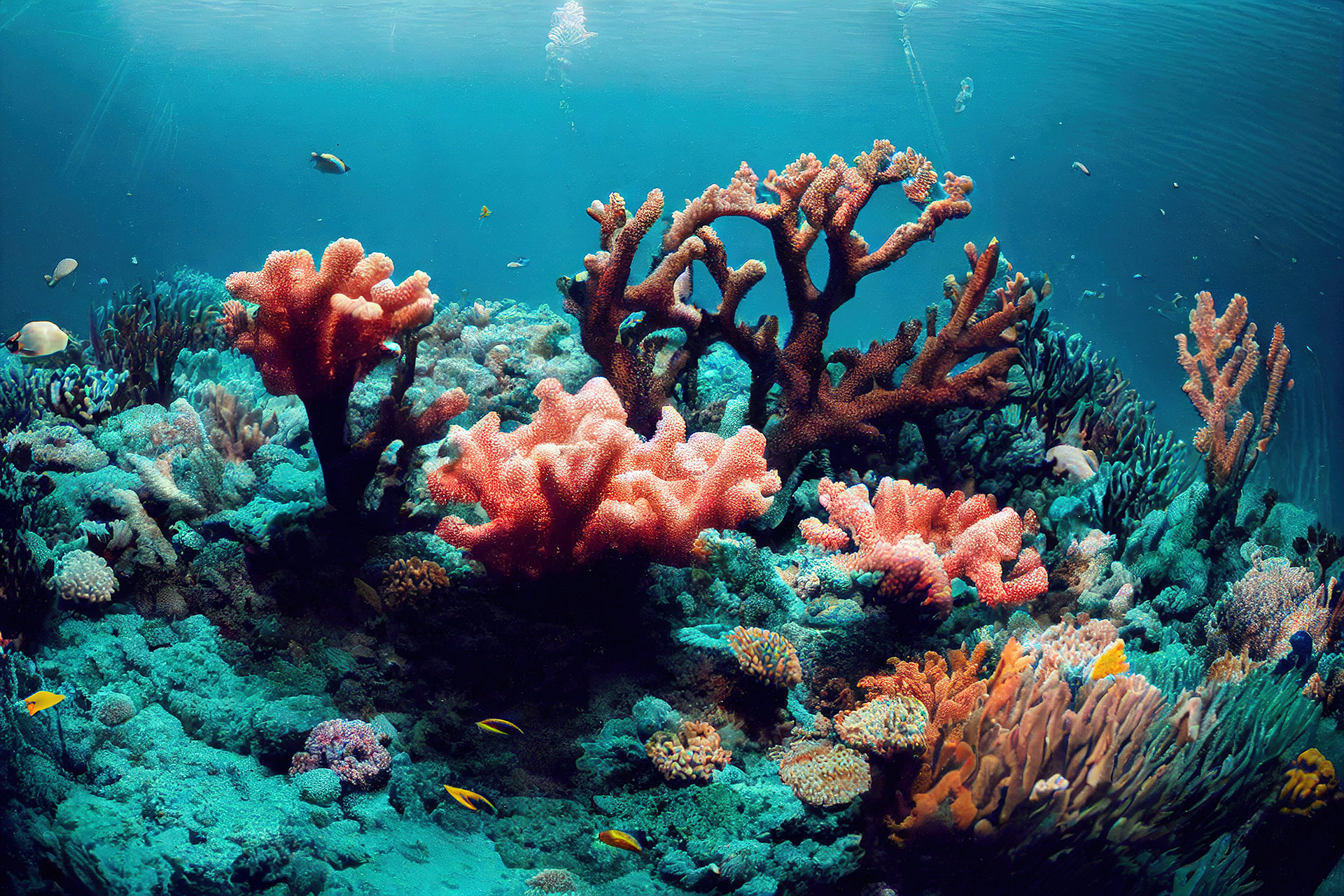
Coral has always been considered a plant. Logically it looks like a tree with roots. The ancients Aristotle, or Pliny the elder had classified it like a plant. In 1726, a coral-loving doctor, living in Gadeloupe- Jean-André Peyssonnel submitted an iconoclastic article suggesting that it is an animal. The academy refused its publication and Réaumur, like Jussieu, vehemently rejected this idea. The poor amateur published his conclusions in England; it is neither the first nor the last time that the academy has shown its conservatism and its lack of scientific judgment. Buffon will classify corals as animals a little later.
Since then, the evidence has been accumulating! Recently, studies have looked into this phenomenon, as impressive as it is magical, at the beginning of summer, after the full moon, the polyps release their eggs and spermatozoa into the water in an enormous cloud. the rest is known, a fertilized egg becomes a larva which takes root, clings to the ground and develops an exoskeleton. How do corals synchronize their actions? In fact, a Japanese study shows that water temperature is crucial, it will open the spawning window which will then be punctuated by rain and solar radiation. Sakai and his colleagues carried out this work in a suitable environment, the ocean not easily lending itself to these measurements and especially to the demonstration of the effects of their modification. They used the enormous aquariums that they have been studying for 15 years and were thus able to intervene to modify the conditions.
All this brings us back to our good old problem of global warming and these harms. We cannot help but admire the beauties of Nature and our behavior of wanting to dominate everything and adapt to our needs and our consumption.
Tout cela nous ramène à notre bon vieux problème du réchauffement climatique et de ces méfaits. On ne peut s’empêcher d’admirer les beautés de la Nature et notre comportement de tout vouloir dominer et adapter a nos besoins et notre consommation.
https://royalsocietypublishing.org/doi/pdf/10.1098/rsos.240183