For several years now, I have been working with my colleagues on treatments for autism and various brain diseases and tumors based on the loss of brain inhibition. At the heart of this system is the regulation of intracellular concentrations of various ions, particularly chloride levels. As I have summarized many times, these levels largely determine the effectiveness of inhibition. Based on this, we have been able to show that an agent that restores low intracellular chloride levels by blocking the transporter involved (NKCC1)—bumetanide—is effective in reducing the severity of autism in many children (https://leblogdebenari.com/en/2026/03/20/a-first-in-autism-artificial-intelligence-helps-identify-children-for-whom-bumetanide-could-be-considered-as-a-treatment/)
Furthermore, numerous experimental studies and clinical trials suggest similar changes in many other diseases and syndromes. These include epilepsy, cerebrovascular accidents, Parkinson’s disease, neurodevelopmental syndromes such as Fragile X syndrome or Rett syndrome, Alzheimer’s disease, brain tumors—including glioblastomas and gliomas—and chronic pain, among others. In a patient with glioblastoma, high NKCC1 activity is a sign of a poor prognosis, as glioblastoma is typically stage 4 or 5. In fact, in all these diseases, NKCC1 is hyperactive, leading to elevated intracellular chloride levels and the resulting cascade of effects.
Furthermore, bumetanide was discovered more than three decades ago to treat cerebral edema and hypertension. It has been used by millions of people with few side effects—notably increased urination and dehydration. It has since become a generic drug, meaning it is no longer protected by a patent, which makes it difficult to raise significant funds for clinical trials, given that it can be synthesized and marketed by any company. As a result, despite very positive results, like other companies, we are having difficulty convincing the pharmaceutical industry to invest in these approaches.
That said, given the large number of syndromes and diseases for which this treatment could be useful, I felt it was important to synthesize analogs by modifying the structure in order to expand the range of available molecules and test their effects in relation to various syndromes. This synthesis should make it possible to conduct clinical trials, as the new molecules are protected by their structures regardless of their intended uses.
I am pleased to announce that we have successfully synthesized 120 analogs and tested their effects on the transporter in human cell lines. We systematically modified 1 or 2 of the molecule’s 4 modifiable sites (image). We have shown that many of them are as effective as bumetanide and, in some cases, even more inhibitory than the parent molecule—which, to my knowledge, has never been achieved before.
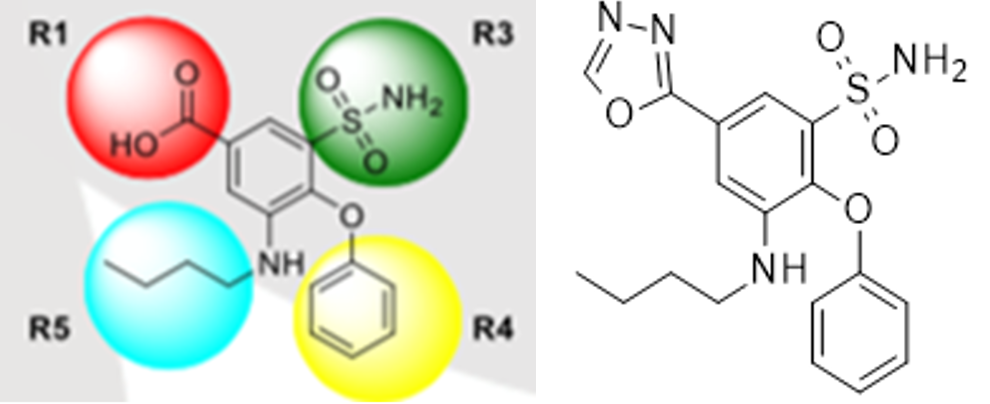
This wide range of molecules opens up numerous possibilities for better understanding how the transporter is inhibited and, above all, for developing new treatments for brain diseases. It is becoming possible to consider that a particular modification might be effective for treating a specific disease, while another might be effective for a different syndrome. Of course, the road ahead is long and costly, as these molecules must first be tested in preclinical studies to determine their safety in humans. Nevertheless, this opens up new pharmaceutical opportunities. I will endeavor to test the most promising of these molecules to clarify their therapeutic potential.
https://www.frontiersin.org/journals/chemistry/articles/10.3389/fchem.2026.1804888/full