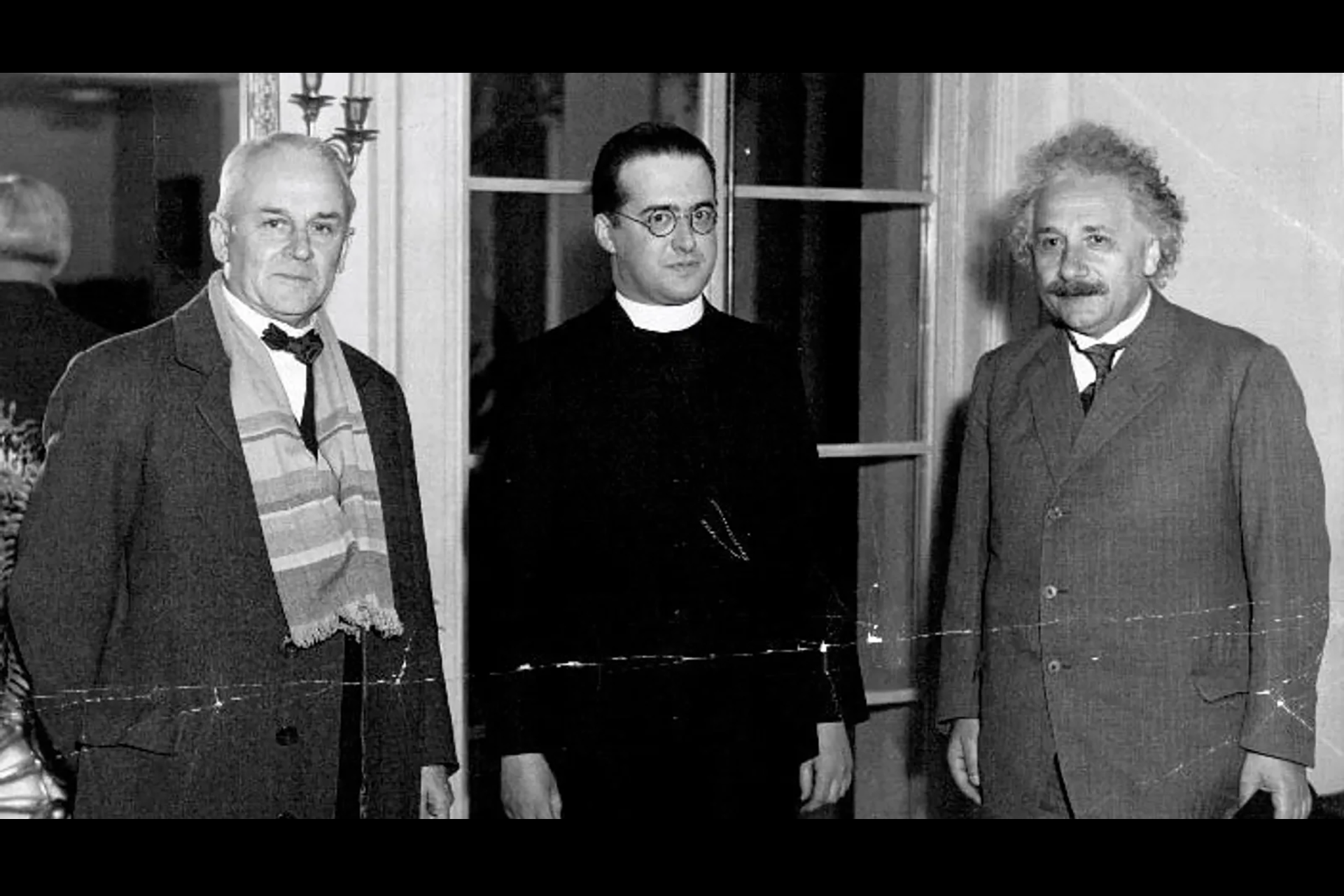
We often wonder how to reconcile two fields as distant as science and faith. In the former, there are no absolute certainties, and any proposition or law can be challenged by new data, which is how our knowledge progresses. In the latter, there are dogmas that do not need to be proven and remain valid. For my part, it is God’s response to Job that has always led me to reject the impact of religion, or should I say monotheistic religions. Indeed, we remember that Job, a fervent servant of God, suddenly suffered all kinds of misfortunes because the Devil challenged him to remain faithful to God if misfortunes made his life difficult. As a result, Job lost everything, his family, his possessions, etc., but remained faithful to God. In a wonderful chapter of the Book of Job, Job asks God for explanations, and God replies that He counts the drops of water in the oceans and the grains of sand in the deserts and knows things that man, by definition, cannot know. Clearly, there are questions he cannot ask. But here, it seems to me, is where the scientist’s criticism and the indomitable nature of science come in. For we are free to ask any question, including, and perhaps especially, those whose answers are far from obvious.
Pastor Georges Lemaître is an exception in this field. An extraordinary pastor and scientist, he is the originator of the Big Bang theory and also of the expansion of the universe. The latter was published two years after him—but in English—with the idea that it had been discovered across the Atlantic…as is often the case. “A Catholic priest with a deep faith, Georges Lemaître rejected concordism, that is, the exegesis of biblical texts as being in accordance with scientific knowledge. He considered that science and faith are ”two paths to truth,“ both legitimate, but that they cannot be mixed, because they are two different approaches.” Even the Big Bang did not pose a problem for him in terms of God’s creation of the universe. “I have too much respect for God to turn him into a hypothesis of physics.”
On the part of the Church, Georges Lemaître’s discoveries never posed a problem. “He was always held in high esteem by Popes Pius XI, Pius XII, John XXIII, and Paul VI,” reveals Dominique Lambert. He was appointed to the Pontifical Academy of Sciences when it was founded in 1936, and became its president in 1960, receiving the title of prelate on that occasion. The Church showed more tolerance than it had with Galileo a few centuries earlier. A free spirit ahead of his time, seemingly tolerant and an excellent teacher, he showed that religion could also be tolerant and open-minded—as did scientists such as Einstein, who appreciated him. Unfortunately, times have changed considerably.
Photo : Robert A. Millikan, Georges Lemaître et Albert Einstein à l’Institut de technologie de Californie, janvier 1933 / Domaine Public